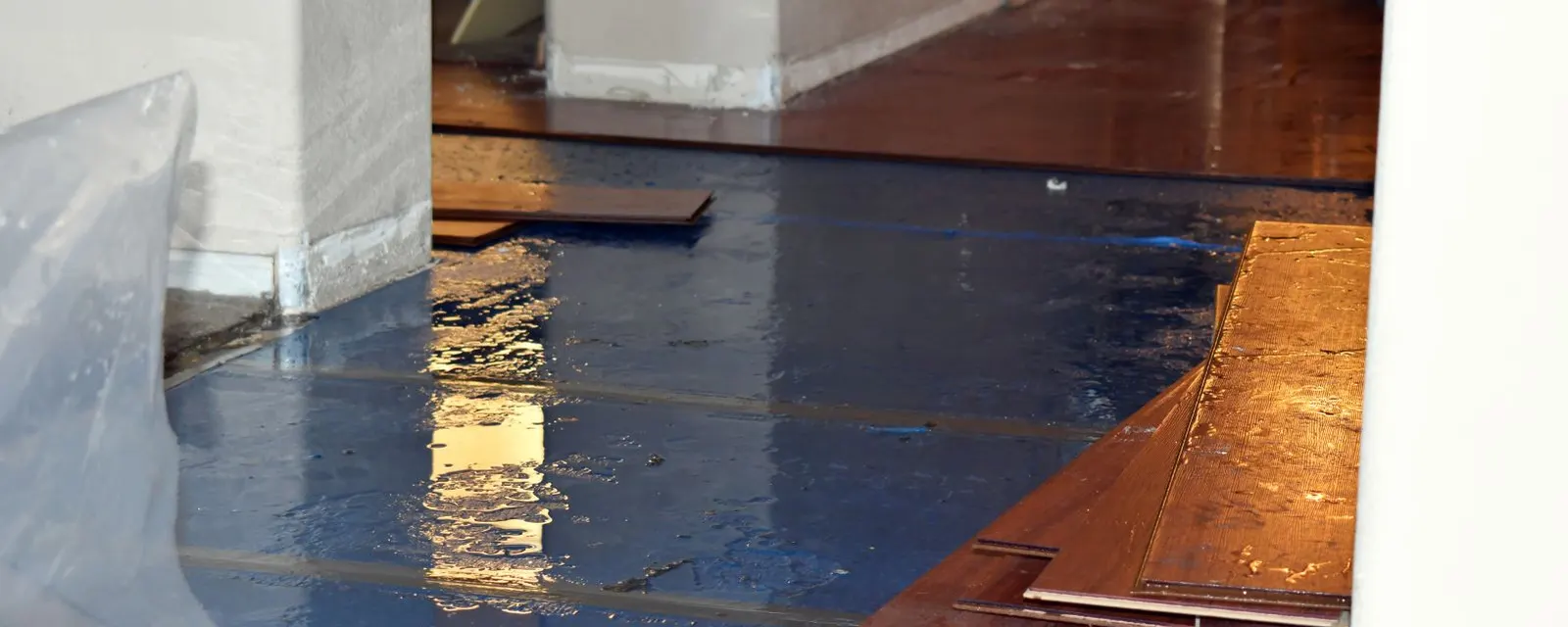
The Four Phases, in the Order They Have to Happen
Repair from water damage looks like a carpentry job, but it begins with plumbing and physics. Water has to stop arriving, the building has to release what it absorbed, and only then do new materials go in. A new drywall sheet screwed over a damp stud starts absorbing that moisture on day one.
Phase one is stopping the source: a closed valve, a repaired supply line or a patched roof. Phase two is extraction and drying. Phase three is removal of anything that will not dry, such as soaked insulation and carpet pad. Phase four is the rebuild, from drywall to paint.
If you are still in phase one or two, our water mitigation service covers the first days. Phase four is described on the water damage repair page.

What You Can Do and What Needs a Crew
| Situation | Reasonable for a homeowner | Call a crew |
|---|---|---|
| A small spill dried within hours | Yes, with towels and a fan | Only if the floor stays damp |
| A stain on a ceiling after a leak was fixed | Check dryness with a meter if you own one | If the board is soft or the stain grows |
| Water on a basement floor | No | Yes, for extraction and drying |
| Wet insulation or a wet wall cavity | No | Yes, because the cavity needs drying |
| Any sewage or storm water | No | Yes, because it is contaminated |
Category 2 and 3 water should not be handled without protective equipment.
What Gets Replaced and What Gets Saved
A general rule is that porous materials that stayed wet for more than a day or two come out, and solid materials can usually be cleaned and dried. Insulation, carpet pad and particle board are in the first group. Concrete, tile, solid lumber and many hard flooring surfaces are in the second.
Drywall is the in-between case. A sheet that is firm and dry with a surface stain can sometimes stay, while one that is soft, swollen or wet for several days is cut out. Cuts follow the nearest framing so the new board has something to fasten to.
How Long the Whole Process Takes
Drying often takes several days, and the rebuild adds more. A small ceiling patch can be done in a day or two after the board dries, while a finished basement with new drywall, paint, trim and flooring is a multi-week project.
Those timelines depend on the water category, the square footage affected and how fast materials are ordered. A reliable contractor writes the scope down before work starts so you can compare steps instead of guessing.
Mistakes That Cost Money Twice
- Painting over a stain before the board is dry
- Closing a wall before moisture readings confirm it is dry
- Replacing flooring without fixing the leak that ruined it
- Ignoring a musty smell, which can point to hidden mold
- Throwing away damaged items before photographing them for your insurer
The mold risk is real in a wet closed wall. If you smell must or see dark growth, the steps on our mold remediation page come before repairs.
Lehi Numbers and Permit Notes
The Census Bureau reports a median owner-occupied home value of $612,100 in Lehi for 2020 through 2024, and 75.2 percent of housing units are owner-occupied. A repair that protects that much value deserves a written scope and a moisture reading at the end.
Lehi City's Building and Inspections department accepts permit applications through its portal and asks for 24 hours notice before an inspection. Its page lists checklists for new construction, additions and basement finishes. It does not list water damage repair as a permit type, so ask the department whether your project needs one.
Source types: U.S. Census Bureau QuickFacts for Lehi, Lehi City Building and Inspections page.
Reading a Moisture Meter Before You Close Anything Up
A moisture meter turns a guess into a number. A pin meter reads moisture between two probes pushed into wood or drywall, and a pinless meter scans the surface without leaving holes. Neither reading means much without a baseline, so crews also read a dry wall nearby and compare.
The goal is not zero. The goal is a reading that matches the dry reference material in the same room, taken at several points, on more than one day. A wall that reads dry at noon and damp after a cool night is still giving water back.
Ask whoever does the repair to show you the readings and where they were taken. A written log with dates is the simplest proof that drying actually finished before new drywall went on.
A Sample Repair Sequence for a Finished Room
- Photograph everything, then shut off the water source and the power to wet areas.
- Extract standing water and remove carpet pad, wet insulation and swollen trim.
- Set air movers and dehumidifiers, then log readings every day until they match the dry reference.
- Cut out board that stayed wet, following the framing, and let the cavity air out.
- Hang, tape and finish new board, prime the repair, then paint the full wall so the patch does not show.
- Install trim and flooring last, after the finish work is dry.
Painting only the patch is a common shortcut that shows in side light. Painting the whole wall from corner to corner costs a little more and hides the repair completely.
Choosing Who Does the Rebuild
Some companies handle drying and rebuilding together, and others dry the building and hand you a clean, dry shell. Either way works if the scope is written down. Ask who is responsible for the final moisture reading and who pulls permits if the work needs one.
Ask whether trades such as electrical or plumbing are done by licensed contractors, and keep copies of any inspection sign-offs. Those papers matter later if you sell the home.
If water is still present right now, start with water mitigation and come back to the rebuild once the structure is dry.
Documentation Helps Your Claim
Sudden and accidental water damage is often covered by homeowners insurance, and gradual leaks and neglect often are not. Take wide and close photos before you touch anything, and keep receipts for emergency steps.
Ask your insurer what it requires. We never promise a claim will be approved.
Want a scope in writing?
Call and describe the damage. We explain how scope and price are set before work starts.
Call (385) 988-9410If you live outside Lehi, the same steps apply in American Fork and Saratoga Springs.
Common Questions
Lehi's Building and Inspections page lists permit checklists for new construction, additions and basement finishes but not water damage repair. Permit rules vary by scope, so ask the department before you start.
A moisture meter reading at or near the dry reference for that material, taken inside the cavity as well as on the surface.
If the board is firm and dry, a stain-blocking primer and paint can work. If it is soft, sagging or still damp, replace it.
Photograph everything first, and keep damaged materials if the insurer asks to see them. Ask your insurer before you discard large items.